B II O II O II K II S
NOVELS
RASHINGOR - St. PETER'S WOOD - THE STREET OF SECRETS - THE RETURN OF RAMON - CAREFULLY - FOUR FISH THAT SING
TRANSLATIONS
THE DUCHESS OF AMALFI'S STEWARD - CASTELVINS AND MONTESES
NOVELS

The Illusian Sequence
There are four books in the sequence, all dealing in some way with fantasy, that is, with stories that marble actual experience and imagined experience. They can be read perfectly well independently, but reading them in order provides a different kind of satisfaction, allowing the reader to follow themes, some of them formal, many, although not all of them, wholly or in part related to imagined experience. Death is a recurrent theme, for example; it has to be an imagined experience, since none of us has yet experienced it otherwise. And art is, of course another one.
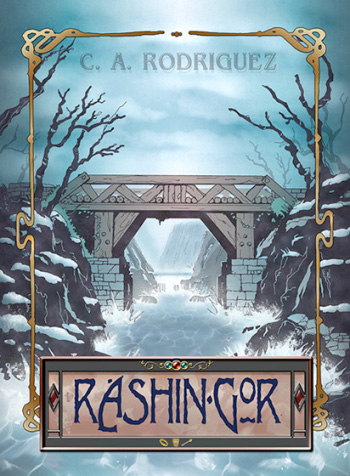

RASHINGOR
RASHINGOR emerges from bringing together several very old forms: fairy tale, narrative song, and medieval heroic romance (which was often in verse). In this world what used to be called marvels—things none of us has experienced, but which we can imagine experiencing—are a natural part of the way things are. In this world, if you can imagine it, it can happen.
During the turmoil of the feminist revolution of the 1970's, C. A. Rodriguez was deep into the study of medieval heroic narrative when she decided to write a novel. It would be a fairy tale about three sheltered sisters going out to encounter the world of men, but the focus would not be the pretty youngest sister, as is traditional, but the ill-favored eldest, called Grundahunch. And for Grundle and her sisters, it would be both a women's journey and a heroes' journey.
The first editor who read RASHINGOR, loved it, but couldn't persuade her board. The publishers of niche fantasy explained that they only published "straight fantasy." The publishers of literary fiction at major NYC houses were stumped. It's "vigorous and original," they conceded, "well done and admirable," "charming and special," "intriguing," and a "tour de force of its kind" (whatever its kind was). They praised the "impressive assurance and ease of its tone," and some said again simply, "I love it!" But in the end they just weren't up to taking the chance.
Grundle and her sisters were ready to take on the world, but the world wasn't ready for them.

From RASHINGOR:
"Forgive me, dearest daughters," it read, "for I love you more tenderly than you can know. You must not think I love you any less because I do this. Even now, when the feelings rush up, I find it impossible to commit them to words. There is so much children cannot understand. Ever since she died I have been tormented. I have questions only she can answer...
"...God bide with you, my dears. I go on a journey none has gone before, save Orpheus, Aeneas, and Odysseus. In such heroes footsteps tremble my old foot. I go to speak with our beloved dead, your mother, to see what no one who is living presently has seen, to know the unknowable—I, the humblest of men."
Sample songs from the book:
A Maiden's Song. The prologue to RASHINGOR, sung by Casey Calhoun.
The Horseman in the Snow. Guitar instrumental by Tom Buckner.
The Horseman in the Snow. Sung by Andrew Calhoun.

St. PETERS WOOD
ST. PETER'S WOOD is set in a quasi-Victorian time, pushing into the twentieth century. Marvels are a thing of the past, but in this world what is now called the wonderful is not altogether gone, just not overt or really visible. It is buried, as one character puts it "in the ore of the ordinary."
Veronica Holystone, a widow "no longer young," has taken refuge in a large, isolated house deep in St. Peter's Wood that has been left to her by a madwoman. With the house come two unusual dogs and also, as Veronica is to discover, the curious power to release latent powers in others.
When the path of her evening walk crosses that of an uneasy horseman who has lost his way in the woods with a snowstorm impending, her life begins to change, as do the lives of a number of other people.
From St. PETER'S WOOD:
In a clean, cold twilight of deep winter, I was talking with the dogs in St. Peter's Wood. Behind us the low sky was softly unrolling over the treetops another night of snowfall. Before us, gated by the black bars and arches of the trees, the west was split open to receive the refulgence—scarlet and gold—of a setting sun, and you could see heaven. There was no one. Only the dogs and myself. An the forest in winder is quite colorless.
There are times in the deep winter when I feel that I cannot bear it, that I will never live to see spring come again...
...And then from time to time, there are moments of the purest hope. As if the cruelty of snow and cold and barrenness and heavy darkness striped earth down to its silences. Then and only then can we hear things we have never heard before. I remember quite explicitly that this is what I was thinking.

THE STREET OF SECRETS
THE STREET OF SECRETS, like RASHINGOR and St. PETER'S WOOD, is set on the fictitious Isle of Hir, this time in the old stone city of Illusia, known for the salubrious waters of its Blue Bay. But now, some decades further into the twentieth century, the wonderful is not directly visible at all. Imaginative experience, however, even if only in the mind, still defined lives.
A dowdy music librarian has engaged private detective Nodule Bogardus, who lives alone with his smelly dog, D'Artagnan, to find the vandal who sliced the blank flyleaf from the back of a music book. Who on earth cares?.
But as it's off-season and he's got some time, another investigative prowler of the city's crooked streets, Bogardus's oldest friend, Chief Inspector Rene Titoque, offers to help. He's made especially curious by the fact that there are two names on the card that he recognizes.
And one of them is the name of a man he sent to prison years ago, whose girlfriend, smoldering chanteuse Sindrice Oyez, has long been the object of many a man's most glorious fantasies.
From THE STREET OF SECRETS:
Bogardus took up his impatient thought again. "Lord love a lunatic, the blank page could have contained coded blasphemies in Chaldean copied with lemon juice backwards for reasons no reason could fathom, we'll simply never know. How could anyone lacking supernatural assistance be expected to find that out? Believe me, I've considered summoning the devil recently, but to learn who took the blank flyleaf from a library book is not worth even my deeply devalued immortal soul."
Titoque smiled. "But it's interesting in its way, Nod. On the face of it, so trivial. And yet, what if it isn't?"
"What if chewing my socks is the secret of eternal youth?"
"Not worth the price."
"My point exactly."
"And in the end unlikely."
"Though I say so myself."
"You're not wrong, of course."
"That is ever my comfort."
"But approaching from the other direction, it—something about this whole business, either the page itself, or maybe about the mere action of the removal of the page—is apparently of some importance to this woman who has consulted you."
Sample a song from the book, Teetering On the Brink. Piano instrumental by Ruby Forest-Bard.
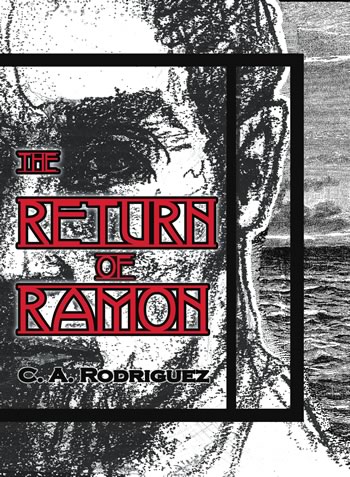
THE RETURN OF RAMON
THE RETURN OF RAMON is the darkest novel of the Illusian Sequence and most references the previous books, set again in the old city of Illusia and its environs. But now the relationship of the wonderful to the world the characters live in is much more problematic. THE RETURN OF RAMON is perhaps the story of an undying love. Or perhaps not.
It begins when Sally Perdue, the night waitress at an all night diner, picks up an exceptionally large tip and an unmailed letter left by a moody regular who does not speak.
From THE RETURN OF RAMON:
The moon was large, round and very white, shining with unusual brilliance. The night was still, but brutally cold. And there was white frost on the landscape, as if a star had shattered, strewing a fine, sparkling debris over all the visible landscape.
And yet there were half a dozen skaters on the hard pond. Thick-sweatered and athletic, with knitted wool well-wound around their throats, even up to the eyes, and well-gloved hands. The scrape of blades was explicit in the stillness. No one spoke much, perhaps unwilling to gulp the cold. But some skated in couples, and some did small tricks that others, moving leisurely by, turned to see.
Ramon leaned against the car, one foot on the running board, his hands shoved deep into his pockets...
The pond was perfect. It should have been perfect.
Small but extremely deep, with underwater channels...
He began to think about how he would do it, as he had a hundred times. She would fight him, of course. And he was not as strong as he had been in the beginning.
Other

CAREFULLY
CAREFULLY, written a number of years after the Sequence, takes place in a fictional Mid-Hudson town in our current century, and it s gentle send-up of the idea of Divine Purpose. In this story, a group of ordinary people navigate their lives on a plane somewhere between the fact of a wild crow called Scaramouche, who complacently triggers chaos, and the idea of an angel called Natalion, Angel of Unexpected Blessings, presumably the messenger of some underlying order.
At the center of it is Father McGavin Gordy, an eccentric Catholic priest defrocked many years ago when he decided to marry. In wildly unpredictable ways that are not always benign, the influence of his actions and decisions ripple outward and affect even people who never knew him.
From CAREFULLY:
Father McGavin was visited by an angel that morning. He saw it at the moment of waking, through slitted, sleep-softened eyes, a shimmering radiance in the air of the room. And he could smell the scent of it as well. It seemed a normal thing, like something he had been walking towards all his long life. And yet he held his breath, waiting for it to speak. When angels come, they come with a message.
...
But the room was silent except for the rackety chirp of birds outside and the occasional caw of a crow. And so in a few minutes he opened his eyes. He's had to exhale to breathe, after all. And it was gone.
Or rather, in its place was the momentarily brilliant effect of a morning sunbeam through a glass full of water on his dresser, into which Jenna Clare had stuck a fistful of hyacinths. That was all.
NEW!
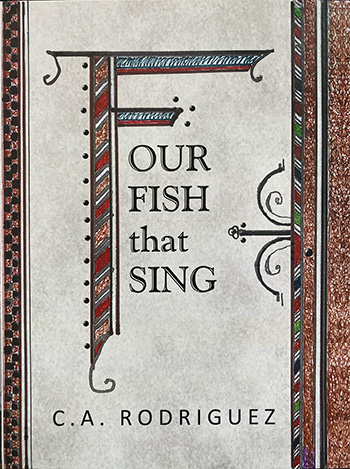
FOUR FISH that SING
FOUR FISH that SING, returns again to the fictional Isle of Hir, this time to the once-busy seaport town of Port Finny shortly after WWII. At a small cafe on the edge of town chance meetings happen and unlikely crises converge for proprietors, regulars, and a couple of young strangers—Mimi Florwashing and Simeon Runcible—from opposite sides of the ocean, who never intended to be there at all.
To the cafe also comes a man with the odd Hiran name of Chinquei Toibocks, traveling with his small granddaughter and an exquisite carousel made by his own hands. Both savior and in need of saving, Toibocks is deeply an artist, a man whose life has been about making beautiful things, and a wanderer haunted by old regrets.
The tone of FOUR FISH is both sunlit and elegiac, its telling wrapped by a moody ocean and the sense of time passing.
From FOUR FISH that SING:
Only a long stretch of desolate beach lay along the water that way, extending almost a mile from the base of Finny Rock's sloping back. And on this sightless night—with sound, the monotonous thunk of waves slapping down on the sand and sliding back again into the endless ocean, being the only perception by which to distinguish invisible sea from invisible land—an exhausted man stumbled, groping, towards the eternal flame of Port Finny's garbage depository. In the blind darkness it was his lone beacon.
Still with the terror of drowning in him, he recoiled from that rhythmic, monotonous sound, the heavy thunk of grasping waves and then the long receding slish, and barely having escaped the water, he felt fantastically as if he were drowning now softly in enveloping but impalpable darkness. He breathed darkness gasping, desperately, fearfully...
...He reached in the air as if to grab darkness to hold onto. His fists held nothing, his balance unstable. He dared not drop down. No! Forcing himself, forcing one step and then another...another...until his knees buckled and his body crumpled under him.
The last sound his mind was aware of was the thud of a great wave. He did not hear the slish of its receding.
TRANSLATIONS

During Shakespeare's lifetime the most famous playwright in the world was a Spaniard, Don Felix Lope de Vega Carpio, a madly prolific, wildly inventive, incomparably popular and internationally influential writer, who wrote in every genre then current, but most prominently plays. Inevitably, since it was common practice to mine Italian sources, Lope left us plays that are analogues of more than one prominent English drama of the period.
In order to write first a Master's thesis comparing John Webster's dark DUCHESS OF MALFI with Lope's analogue, and then a PhD dissertation comparing Shakespeare's ROMEO AND JULIET with Lope's analogue of that play, C. A. Rodriguez had to first produce translations and then publish them in the prestigious Carleton Renaissance Plays in Translation series, because not all her advisors could read Spanish. Both of Rodriguez's translations are in unrhymed verse, following the structure of the rhythmic patterns in the original Spanish verse.
The books are in libraries all over the world but the entire series is no longer in print.


The DUCHESS OF AMALFI'S STEWARD
by Lope de Vega

CASTELVINS AND MONTESES
by Lope de Vega